
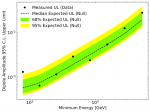
Collaborators from Fermi-LAT realized that the abundance of cosmic-ray protons in the LAT data set might enable them to measure cosmic-ray anisotropy, and so they conducted the first search for cosmic-ray proton anisotropy using Fermi-LAT data. They present their results in a paper published last week in The Astrophysical Journal.
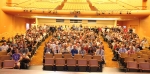
It has been a week since the 36th International Cosmic Ray Conference ended in Madison, WI. Over the course of eight days of meetings, 815 participants from 39 countries gathered at Memorial Union at the University of Wisconsin–Madison. In total, the meeting yielded 1,056 papers, 406 oral talks, 650 posters, 35 plenary talks, two diversity events, a public lecture, and an art gallery.

The 36th International Cosmic Ray Conference (ICRC) kicks off tomorrow in Madison, WI. ICRC is a physics conference organized biennially by the Commission on Astroparticle Physics (C4) of the International Union of Pure and Applied Sciences (IUPAP) in which physicists from around the world present the results of their research in astroparticle physics.

The sixth edition of the IceCube Masterclass hosted over 150 students at 13 institutions in Belgium, Germany, Switzerland, and the United States. The masterclasses were held on January 30, March 20, April 4 and April 11.
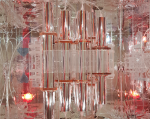
the COSINE Collaboration today presents the first results that significantly challenge DAMA’s claim of a dark matter observation. The paper, published this week in Nature, does not reveal any excess of interactions that could be attributed to dark matter.
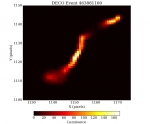
A team of researchers at the University of Wisconsin–Madison has developed an algorithm for identifying images of cosmic rays taken by smartphone cameras. The new algorithm uses data from the Distributed Electronic Cosmic-ray Observatory (DECO), a smartphone application that uses the phone’s camera sensor to detect cosmic rays and other energetic particles.