

There are
“WIPAC”
567
Friday, November 22, 2013 - 12:30pm
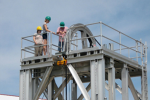
Since 2009, WIPAC has partnered with the Knowles Science Teaching Foundation (KSTF) and PolarTREC to send high school math and science teachers to the South Pole, working closely with scientists and engineers on the IceCube Neutrino Observatory.

Thursday, November 21, 2013 - 1:15pm
Today, nearly 25 years after the pioneering idea of detecting neutrinos in ice, the IceCube Collaboration announces the observation of 28 very high-energy particle events that constitute the first solid evidence for astrophysical neutrinos from cosmic accelerators. Details of this research will be published tomorrow, November 22, in Science.
Monday, November 18, 2013 - 11:30am
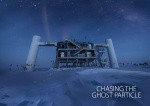
Get ready for a journey you will never forget. The fulldome planetarium show Chasing the Ghost Particle: From the South Pole to the Edge of the Universe will open at the Milwaukee Public Museum’s Dome Theater on November 21, 2013, at 7:30 p.m. The show takes audiences on an amazing 30-minute trip from the most extreme places in the universe to inside the IceCube telescope, a huge detector buried deep in the Antarctic ice.

Friday, September 6, 2013 - 11:45am
By 2010, the year that construction was completed, it was clear that the IceCube Neutrino Observatory, a project inspired and led by UW–Madison scientists and engineers, was one of the most amazing international science projects of the last few decades. Since then, scientists all around the world have been screening the data from the detector for traces of very high-energy neutrinos, which could reveal the source and nature of cosmic rays
Monday, April 15, 2013 - 1:00pm
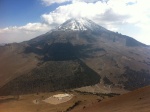
As covered in a recent BBC article, Wisconsin IceCube Particle Astrophyics Center (WIPAC) postdoc Tom Weisgarber shared results at the April American Physical Society meeting from the High-Altitude Water Cherenkov gamma-ray observatory, or HAWC.
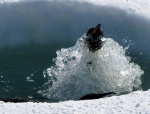
While work at the IceCube Neutrino Observatory focuses on the edges of the Universe, the public is often interested in something which resides on the edges of Antarctica- penguins.
Public interest in penguins recently provided IceCube researcher Mark Krasberg of the University of Wisconsin-Madison with an edge in the UW-Madison Cool Science Contest where he won an award for his photo of an emperor penguin leaping out of the water.