

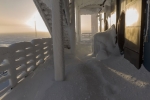
Although the South Pole is essentially a desert, a hefty accumulation of snow occurs on and around the buildings there each winter. How is that? Well, it’s the wind. Antarctica is a windy place—even with so little precipitation, it features some extraordinary blizzards thanks to strong winds.

A recent work by Markus Ahlers, a John Bahcall fellow at WIPAC, has shown that fluctuations in the cosmic-ray dipole anisotropy can be understood once the local magnetic field and the presence of local CR sources are taken into account.

Flags serve an important purpose at the Pole, marking out routes between places for when visibility is poor. Here you can see the IceCube Lab (ICL) in focus behind a flag line in the foreground.

This summer, two students worked with WIPAC throught the Research Experiences for Undergraduates program at UW–Madison. We have talked to them to learn about what brought them to Madison and what they are now taking back with them.
