
Are you ready for a South Pole challenge? The South Pole Experiment Contest is a competition for middle school students in the US, Germany, and Belgium.
Here comes a burst of electromagnetic radiation, a radio burst to be more precise. It lasts for a few milliseconds, then stops. Usually, nothing more happens—although they have been found to repeat. Still, these radio flares, or fast radio bursts, as scientists call them, may tell us a good deal about the universe if we ever discover where and how they are created.
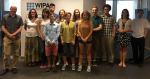
In the northwest corridor at WIPAC, voices are sporadic once again. The open work area next to the help desk team is now mostly dark with empty tables and bare walls. But it has not always been like this. Certainly not during the last few weeks, when this space was one of the most active areas on the floor.
Summer is a hot season for science conferences. And in astrophysics, the International Conference on Cosmic Rays (ICRC2017) was a must. This recent event had a strong WIPAC presence, with six talks and and seven posters presented by our researchers, covering new results and future developments for the neutrino observatories ARA and IceCube, the gamma-ray detectors HAWC and the Fermi Large Area Telescope(LAT) , and outreach projects such as DECO and the wide-reaching IceCube education and outreach program. The ten-day conference ended on July 20, in Busan, Korea, with the exciting announcement that UW–Madison will be hosting ICRC2019.
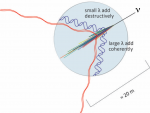
Kael Hanson, WIPAC director and a professor of physics at UW–Madison, has been awarded a UW2020: WARF Discovery Initiative grant to explore the potential of the Askaryan radio detection method in the future upgrade of the IceCube Neutrino Observatory, the so-called IceCube-Gen2 facility.

The Wisconsin IceCube Particle Astrophysics Center (WIPAC) was excited to recently host two meetings on the UW–Madison campus. The IceCube Collaboration spring meeting was held from May 2–6 at Union South, and the 2017 IceCube Particle Astrophysics Symposium: Multimessenger Astronomy (IPA 2017) followed, from May 8–10, at Discovery and Union South.
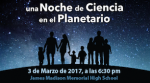
Last Friday, over 150 Spanish speakers came out for a science night in Spanish at the planetarium of the Madison Metropolitan School District (MMSD). The evening, hosted by the planetarium and WIPAC through the program “El Universo es Tuyo,” offered an appealing program: a planetarium show about the moon, activities with IceCube, science books in Spanish from the Madison Public Library, and several hands-on activities to learn about moon craters and eclipses run by UW Space Place and MEChA of UW–Madison. There were even some refreshments, through the generous support of Rocky Roccoco, Chocolate Shoppe Ice Cream, Woodman’s Markets, and Pick ’n Save.