
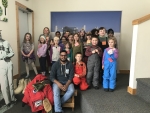
Last week, WIPAC graduate student Rishabh Khandelwal shared his experiences living and working at the South Pole in an outreach talk for homeschool students.
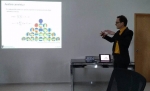
At WIPAC, Juan Carlos Díaz-Vélez leads the simulation production for IceCube, but he has also been busy as a PhD candidate of the Universidad de Guadalajara in Mexico. Yesterday, the Centro Universitario de los Valles (CUVALLES) in Guadalajara awarded him the best post-graduate thesis in 2017, acknowledging his contributions to the study of cosmic rays with HAWC and IceCube.

After a five-year John Bahcall postdoctoral fellowship at WIPAC, astroparticle physicist Markus Ahlers returned to Europe in February 2017. Currently an assistant professor in the Theoretical Particle Physics and Cosmology research group at the Niels Bohr Institute in Copenhagen, Markus is now enjoying one of those dreams come true: the birth of his own research team. A Villum Young Investigator grant for 7.350.000 DDK ($1.2 million), which he was formally awarded on January 23, has secured the foundation of a new research group.
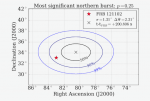
Although fast radio bursts’ (FRBs) progenitors are supposed to be compact and perhaps catastrophic cosmic events that may also produce neutrinos, IceCube has not detected any such neutrinos that could be associated with a known FRB in six years of data. These results are far from precluding the eventual detection of neutrinos from FRBs in the future, but they have set the best limits yet on how many are emitted. The results have been submitted today to The Astrophysical Journal.